1/5/2026
operation absolute resolve
Operation Absolute Resolve (U.S. military supporting law enforcement operation) focused on capturing Venezuelan President Nicolás Maduro and his wife, Cilia Flores, in Caracas to face federal drug trafficking charges. It involved months of planning by the CIA, Pentagon, and Special Operations forces, including rehearsals on a replica of Maduro's presidential compound. The operation emphasized precision, surprise, and minimal ground presence, drawing on maneuver warfare principles. It deployed over 150 aircraft from the U.S. Army, Air Force, Navy, and Marine Corps, launching from approximately 20 bases and warships across the Western Hemisphere. Key equipment included stealth fighters for air superiority, electronic warfare aircraft for jamming, bombers and missiles for suppressing defenses, and helicopters for insertion/extraction. Naval assets enforced a blockade and provided launch platforms. No U.S. personnel were killed, though some were injured in self-defense engagements. Maduro and Flores were extracted and flown to the USS Iwo Jima for transfer to the U.S.
Timeline (VET refers to Carracas time) January 2 - 3, 2026:
- 11:46 PM VET: President Trump issues the Execute Order (EXORD) from Mar-a-Lago. Over 150 aircraft and drones begin launching from 20 locations, including land bases and naval vessels like the USS Gerald R. Ford carrier group.
- Midnight to to 1:55 AM: Aircraft en route to Venezuelan airspace.
- 1:55 to 2:00 AM: First visible signs in Caracas: Residents report hearing the roar of low-flying aircraft, power outages in southern Caracas, and initial explosions. SEAD strikes commence on air defense sites, radars, and military installations (e.g., La Carlota Air Base, Higuerote Airport, Port of La Guaira). Multiple explosions reported across northern Venezuela to blind radars and prevent coordinated response.
- 2:00 AM: Helicopters carrying Delta Force operators arrive over Fuerte Tiuna compound. Helicopters take fire (one damaged but flyable); U.S. forces return fire in self-defense. Delta operators fast-rope or land, breach the residence (prepared with explosives and blowtorches for potential steel safe-room doors). Maduro and Flores are caught by surprise while sleeping; Maduro attempts but fails to reach the safe room. They are secured without resistance from the targets.
Russian Supplied Systems:
- S-300VM long-range surface-to-air missile (SAM) system: A high-altitude, anti-stealth SAM with a 250 km range, designed to counter U.S. stealth aircraft and cruise missiles. Venezuela acquired 1-2 divisions (12 launchers). Neutralized via electronic jamming and strikes on command nodes, preventing any launches. Estimated value: $1-2 billion (part of a 2009-2011 deal)
- Buk-M2E medium-range SAM system: Mobile SAM with a 45 km range for engaging aircraft and missiles. Venezuela had 3-9 batteries, with additional units delivered in October 2024. Multiple sites (e.g., at La Carlota Air Base) were destroyed by airstrikes, with imagery confirming smoldering remains. Estimated value: $300-500 million (including recent deliveries).
- Pantsir-S1 short-range air defense system: Self-propelled anti-aircraft gun/missile hybrid for point defense against low-flying threats. Recently transferred in 2024. Disabled through cyber-induced blackouts and EW, rendering them inoperable during the raid. Estimated value: $100-200 million.
- Pechora-2M (S-125 upgrade) SAM system: Modernized Soviet-era short-range SAM for area defense. Venezuela operated over 6 units. Overcome by initial SEAD strikes and jamming, with no effective response. Estimated value: $150-250 million (upgrade costs).
- Igla-S (9K338) man-portable air-defense system (MANPADS): Portable shoulder-fired missiles for anti-aircraft use, distributed to militia. Limited attempts failed due to U.S. dominance in airspace and EW suppression. Estimated value: $50-100 million (stockpiles).
- Su-30MKV (Su-30MK2) multirole fighters: 21 aircraft forming the core of Venezuela's air force, capable of air superiority. Grounded and ineffective due to radar blinding and strikes on airbases (e.g., Higuerote Airport). Estimated value: $800 million-$1 billion (original 2006 deal).
Overall Russian-supplied air defense network value exceeded $2-3 billion, with total historical arms deals reaching $10-14 billion, much of which was rendered useless in under 30 minutes.
Chinese Weapons Systems:
- JYL-1 Three Dimensional Surveillance Radar: Long-range air surveillance system from China Electronics Technology Group, core to command-and-control. Disabled via EW, causing "catastrophic paralysis." Estimated value: $50-100 million.
- JY-27 metric-wave radar ("stealth aircraft hunter"): Anti-stealth early-warning radar designed to detect U.S. fifth-generation fighters. Neutralized by jamming and strikes, exposing weaknesses in Chinese designs. Estimated value: $100-200 million (acquired for counter-stealth role).
- VN-16/VN-18 armored vehicles: Amphibious infantry fighting vehicles for ground defense. Ineffective without air cover, targeted in strikes on bases like Fuerte Tiuna. Estimated value: $200-300 million (fleet costs).
- SR-5 multiple rocket launchers: Mobile artillery systems for ground support. Rendered useless by disrupted communications and airstrikes. Estimated value: $100-150 million.
Chinese components made up a $6 billion defense investment that proved wholly ineffective.
Iranian Weapons "defending" Venezuela:
- Mohajer-6 (or similar) combat unmanned aerial vehicles (UAVs/drone): Armed reconnaissance drones produced locally in Venezuela via tech transfer (e.g., through Empresa Aeronautica Nacional SA). Ineffective due to jammed communications and strikes on facilities; part of a network facilitating Iranian-Venezuelan drone production. Estimated value: $50 million.
- Shahed-series loitering munitions (e.g., Shahed-107): Kamikaze drones adapted for air defense or strikes, with components supplied via Iranian networks. Overcome by U.S. air superiority and EW, preventing launches (many assembled on Margarita Island by Iranian and Hezbollah operators). Estimated value: $20 million
Total losses to Venezuela in military hardware alone is in excess of $20 billion. More importantly, the Chinese and Russian "top shelf" hardware proved no match for the US military. This not only causes deep concerns for China and Russia it speaks volumes to the nations they are courting around the world.

12/15/2025
The Path to the Bill of Rights: Origins, Drafting, and Enduring Significance
On December 15, 1791, exactly 234 years ago from today, the first ten amendments to the United States Constitution, collectively known as the Bill of Rights, were officially ratified by the requisite number of states, marking a pivotal moment in American governance. This document, which enshrines fundamental protections for individual liberties, did not emerge in isolation but as a hard-fought compromise amid intense debates over the nature of federal power, individual freedoms, and the structure of the new republic. To understand its creation requires examining the historical pressures that necessitated it, the meticulous process of its drafting and ratification, and its profound, evolving importance in shaping American democracy.
What Led to the Bill of Rights: From Colonial Grievances to Constitutional Debates
The roots of the Bill of Rights stretch back centuries, drawing from Anglo-American legal traditions that sought to curb arbitrary authority. Key influences include the Magna Carta of 1215, which established principles like due process and protections against unjust imprisonment; the Petition of Right in 1628, which required parliamentary consent for taxes and condemned unlawful detentions; and the English Bill of Rights of 1689, which prohibited excessive bail, cruel and unusual punishments, and royal interference in elections, echoing provisions that would later appear in the American amendments. These documents reflected a growing emphasis on limiting monarchical power, ideas that resonated deeply with American colonists chafing under British rule.
Colonial experiences further fueled the demand for explicit rights protections. The Stamp Act of 1765, which taxed printed materials without colonial representation in Parliament, sparked widespread resentment, particularly over "writs of assistance" that permitted British officials to conduct warrantless searches of homes and businesses. This violation of privacy and property rights galvanized opposition, reinforcing the view that government power and individual liberty were inherently at odds. As tensions escalated, leading to the Declaration of Independence in 1776, colonists invoked "unalienable rights" such as life, liberty, and the pursuit of happiness, concepts acknowledging all rights ultimately come not from government but from God. In response, many states drafted their own constitutions and bills of rights during the Revolutionary era. Virginia's Declaration of Rights, authored by George Mason in 1776, was particularly influential, proclaiming inherent rights to free speech, religion, and fair trials, and serving as a model for other states and even France's 1789 Declaration of the Rights of Man and of the Citizen.
After independence, the Articles of Confederation (ratified in 1781) proved inadequate, lacking a strong central government to manage interstate commerce, taxation, or national defense. This led to the Constitutional Convention in Philadelphia in 1787, where delegates aimed to create a more robust federal framework. However, the resulting Constitution focused on enumerating government powers, establishing a bicameral Congress, an executive branch, and a judiciary, without a dedicated bill of rights. Figures like Mason and Elbridge Gerry argued vehemently for one, fearing a powerful national government could erode state sovereignty and individual freedoms. Gerry's motion to form a committee on a bill of rights was unanimously rejected, as many delegates, including James Madison, believed the Constitution's limited grants of power, combined with checks and balances, made explicit protections unnecessary "parchment barriers."
Ratification debates exposed deep divisions between Federalists (supporters of the Constitution, like Madison and Alexander Hamilton) and Anti-Federalists (opponents, including Mason and Patrick Henry). Anti-Federalists warned that without safeguards, the federal government might suppress speech, religion, or assembly, or conduct arbitrary searches, echoing colonial grievances. Mason's widely circulated "Objections to this Constitution of Government" pamphlet amplified these concerns, swaying public opinion in key states. To secure ratification, Federalists compromised: In states like Massachusetts, New York, and Virginia, they promised to propose amendments immediately after approval, a tactic known as the "Massachusetts Compromise." The Constitution was ratified in 1788, but only with this assurance, highlighting how public demand for rights protections forced the issue.
How the Bill of Rights Was Drafted and Ratified
The drafting process began in the First Congress in 1789, with Madison, now a Virginia congressman, taking the lead, despite initial reluctance. Influenced by Thomas Jefferson's advocacy from Paris (where he argued a bill of rights was essential against any government), Madison reviewed over 200 proposals from state ratifying conventions, distilling them into a focused set emphasizing individual liberties rather than structural changes to government. On June 8, 1789, he introduced 19 amendments in the House of Representatives, prioritizing protections like freedom of religion, speech, press, assembly, and petition; the right to bear arms; prohibitions on quartering soldiers; safeguards against unreasonable searches and seizures; due process rights; and reservations of unenumerated rights to the people and powers to the states.
Congressional debates were contentious. Some members dismissed the effort as premature, preferring to focus on revenue and organization, while others feared it could reopen calls for a second constitutional convention. Madison persisted, viewing the amendments as a way to educate citizens on their rights, build support for the new government, and preempt more radical alterations. The House refined Madison's proposals into 17 amendments, which the Senate condensed to 12. A joint conference committee resolved differences, and on September 25, 1789, Congress approved the package. President George Washington transmitted the 12 amendments to the states on October 2, 1789.
Ratification required approval by three-fourths of the states (10 out of 13 at the time). Nine states acted swiftly within six months, but holdouts like Virginia delayed the process. On December 15, 1791, Virginia became the tenth state to ratify, making the first 10 amendments (Articles 3 through 12 of the proposed set) part of the Constitution. The two unratified amendments addressed congressional apportionment and pay raises (the latter was eventually ratified as the 27th Amendment in 1992).
The Importance of the Bill of Rights: A Foundation for Liberty and Evolving Protections
The Bill of Rights transformed the Constitution from a blueprint for government into a charter of liberties, explicitly limiting federal power to protect individual rights. Its amendments safeguard core freedoms: The First protects expression and religion; the Second, arms; the Third, against quartering; the Fourth, from unreasonable searches; the Fifth through Eighth, due process and fair trials; the Ninth, unenumerated rights; and the Tenth, state powers. Initially, it applied only to the federal government, as affirmed in Barron v. Baltimore (1833), but the 14th Amendment (1868) enabled "selective incorporation," extending most protections to states via Supreme Court rulings in the 20th century.
Its significance extends beyond text: It symbolized a commitment to limited government and rule of law, calming Anti-Federalist fears and unifying the young nation. However, implementation was uneven. For over a century, courts rarely invoked it, ignoring violations against marginalized groups like enslaved people, women, and Native Americans, who were excluded from its protections until later amendments and reforms. The 13th, 14th, and 15th Amendments addressed slavery and citizenship post-Civil War, but full enforcement required civil rights movements and supreme court cases throughout the mid-20th century.
Today, the Bill of Rights remains a living document, central to debates on privacy (e.g., digital searches), free speech (e.g., online expression), and gun rights. It underscores America's unique contribution to constitutionalism: an independent judiciary empowered to strike down unconstitutional laws, as established in Marbury v. Madison (1803). While critics argue its original scope was narrow and elitist, its principles have expanded through interpretation, making it a global model for human rights. Yet, as ongoing challenges show, protecting these rights demands vigilance against encroachments, ensuring "leadership without limits" on government power, a phrase that echoes the founders' intent to bound authority with unbreakable safeguards.

11/11/2025
The Selection and Journey Home of America's World War I Unknown Soldier
In the aftermath of World War I, the United States sought a profound way to honor the countless American soldiers who had given their lives but whose identities were lost forever in the chaos of battle. On February 4, 1921, Congress passed a resolution approving the burial of an unidentified American soldier from the war at Arlington National Cemetery, a symbolic tribute to the "Unknown" representing all who perished without recognition. This set in motion a meticulous and solemn process to select and return those remains from the battlefields of Europe.
By September 29, 1921, the U.S. War Department issued orders for the Quartermaster Corps to identify suitable remains from among the unidentified Americans buried in France. Working in close coordination with French authorities and the U.S. Navy, a team was dispatched to exhume four bodies, one from each of the major American Expeditionary Forces (AEF) cemeteries: Aisne-Marne, Meuse-Argonne, Somme, and St. Mihiel. These locations were chosen to ensure the selection represented the breadth of the American fight across the Western Front. Each body was rigorously examined by medical experts to confirm it belonged to an AEF soldier who had died of combat wounds, with no dog tags, personal effects, or other clues to identity. The goal was absolute anonymity, a true everyman of the war.
Once verified, the remains underwent careful mortuary preparation and were placed into four identical oaken caskets, each lined with white silk and encased in matching shipping boxes adorned with American flags. This uniformity was deliberate, mirroring the practices of Allied nations like Britain and France, to prevent any bias in the final choice and to symbolize the thousands of unknowns still resting in European soil.
On October 24, 1921, exactly one week before Armistice Day, the four caskets arrived by truck at the city hall in Châlons-sur-Marne, a scarred town near the front lines that had endured heavy fighting. In a hushed ceremony under a canopy of French and American flags, the task of selection fell to Sergeant Edward F. Younger of the U.S. Army's 50th Infantry Regiment. Younger, a battle-hardened veteran wounded in combat and awarded the Distinguished Service Cross for valor, approached the caskets with a spray of white roses, a poignant gift from a local Frenchman who had lost two sons in the war. As a French military band played a somber hymn, Younger circled the caskets several times, lost in thought, before gently placing the roses on the third one. With a salute, he marked his choice, the Unknown Soldier of the United States. U.S. and French officials, including generals and diplomats, paid their respects as the roses remained affixed to the selected casket, destined to accompany it across the Atlantic.
The three unchosen caskets were quietly reinterred in the Aisne-Marne Cemetery, their secrets preserved. The chosen one was then borne in a horse-drawn caisson through the streets of Châlons-sur-Marne to the railroad station, where it was loaded onto a special funeral train provided by the French government. The journey continued through Paris—overnight under the vigilant watch of a U.S. Army honor guard—and on to the port of Le Havre, with crowds of French civilians and soldiers lining the tracks to offer silent tributes, flowers, and prayers.
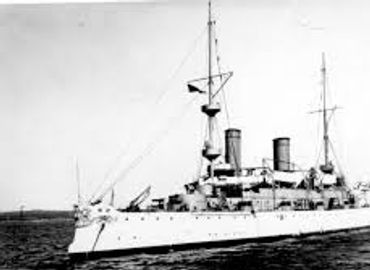
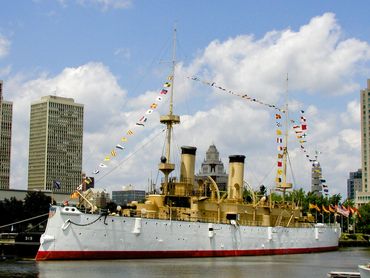
There, on October 25, 1921, at precisely 2:20 p.m., the remains were transferred to the custody of the U.S. Navy aboard the cruiser USS Olympia (CL-15), the storied ship that had served as Admiral Dewey's flagship during the Spanish-American War and was now repurposed for this sacred voyage. The transfer unfolded with profound pageantry at the dock: French Minister of Pensions André Maginot affixed the nation's highest honor, the Cross of the Legion of Honor, to the casket. A detail of six sailors and two Marines relieved the Army escort, piping the casket aboard as it was carried to the ship's stern, blanketed in wreaths, flowers, and a small box of sacred earth from the battlefields of France. Dignitaries, schoolchildren, and throngs of onlookers added their own floral offerings, while the French destroyer division and other vessels fired salutes. With flags at half-mast, Olympia slipped its moorings, escorted by the destroyer USS Reuben James and six French warships, beginning the 14-day transatlantic crossing.
The voyage was arduous, battered by the remnants of a hurricane with towering waves, howling winds, and relentless rain that tested the crew and the 38-man Marine honor guard led by Captain Graves B. Erskine. They stood unwavering watches over the casket day and night, a testament to the soldier's unyielding service. Olympia burned through over 950 tons of coal before reaching the Virginia Capes on November 7, 1921, and docking at the Washington Navy Yard on November 9 amid a flotilla of escorting U.S. warships.
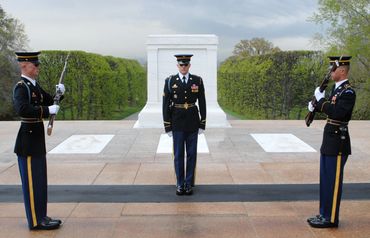
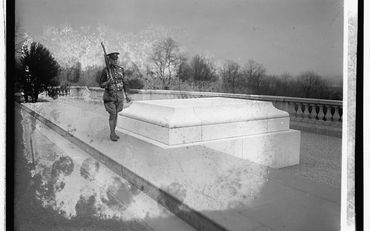
From there, the Unknown Soldier's procession continued: offloaded in a brief but moving ceremony, transferred to Army bearers, and conveyed to the Capitol Rotunda for a day in state. On Armistice Day, November 11, 1921, he was laid to rest in Arlington's Tomb of the Unknowns, a crypt that would later welcome unknowns from other wars, but forever enshrining this first guardian as the emblem of America's sacrifice. In that single set of remains, selected so deliberately from Europe's fields of sorrow, the nation found a timeless story of valor, loss, and unbreakable resolve.
J.J. Brookshire
Master Sergeant (Retired)
TIS: 9 May 1983 - 31 August 2025

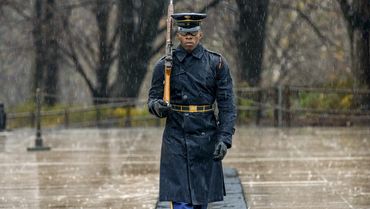
Tomb Guards (3 Infantry) mantain a 24/7 vigil at Arlington National Cemetery.
Photo Gallery